| Overview:
To often the judge will become hung on the
continued reference from the standard that the coat is of prime
importance in the breed. This to the exclusion of expectation of a sound
in body and mind animal on which is draped the characteristic blue and
tan mantle.
However, breeders and judges alike would do this
breed a favor by remembering that these are dogs too and proportionately
have the same number of bones, muscles and teeth as any other breed.
Remember that these little canines must move and must have sufficient
room for all the internal organs that keep them alive and keep them able
to breed AND whelp naturally!
In the ring remember that the Yorkie that runs
across 20 feet will be working harder then the GSD crossing 50 feet!
Those who judge the larger breeds or those who are thinking of judging
this toy please keep this in mind and you will appreciate the need for
FUNCTIONAL conformation in the breeds in the toy group. All breeds in
this group will fall within one of the four body types of canine
structure: low center of gravity, terrier fronts, normal and double
suspension galloper.
Expect all in these breeds that you would expect
on any larger breed! And breeders as well as judges, do not stress a few
characteristic features such as size, coat, expression of head, the
colour of eyes or the set of the ears to the detriment of submerging
functional conformation or any part of it. Do not judge or breed for
just a dark eye, a dark blue silk coat or a well set on ear; first breed
a sound dog and then go for the dark eye, dark blue silk coat and or the
well set on ear, depending on breed requirements as set forth in the
standard. Put functional soundness above everything else whether the dog
goes afield or spends his life curled in someone's lap:-)).
To begin to judge the Yorkshire Terrier one must
keep in mind the original function, which was of a toy-sized terrier, a
ratter, which covers all the small prey of similar size. Despite which
opinion of the antiquity origination of the breed you choose to believe
the one common thread is that the breed was founded on terriers with all
that word entails to judges. You will do the breed and yourself a favor
if you challenge those exhibiting to you to present the same soundness
in body and movement along with alert personality in this toy breed as
you would want to see in any of the terrier breeds. But keep in mind, it
is a TOY-TERRIER which means it is middle ranged toy, not as tall or
large as the Cavalier or Crested not as small as the Chihuahua.
The challenge to the breeder of this breed is the
attempt to get it all correct in one animal. This breed is challenging,
which is why so many take short cuts in trying to achieve what is so
daunting to so many, that being a toy-terrier, silk coat of specificity
in colour and texture, sound body, sound mouth, sound movement.
With that said, keep in mind the standard lists no
fault or disqualification.
And one of the biggest misconceptions affecting
this breed, the standard is a description of an adult animal. If in
doubt ask the age, permitted under AKC rules; don’t expect the clear,
precise coloration of the adult in the young animal. This is the reason
so many of the breed are too light and not holding correct coloration to
their old age. A puppy is born looking just like a Dobe or Rottie but in
a smaller package. Learn the difference in the feel of the coats and
don’t go on the colour alone! A soft coated black dog is precisely that
black! A lighter coloured dog holding the correct blue coloration is to
be more highly prized then a soft coated little black that though it may
fade to a grey never contains the correct blue hue. Hint to judges of
this breed: Get yourself a wide, flat black watch band and compare it to
the adult coat in the ring; if it matches you know they don't have the
correct blue in their coat but are a instead a black and incorrect!
The Yorkshire standard is often one of the most
misinterpreted by judges of the breed. You have to understand the words
and meaning to understand that a clear picture is actually given on the
breed. Following the standard will be broken down in a manner that may
assist you to envision the breed you are judging.
The breed is a challenge and very difficult to get
right as if you get the coat quantity and texture right you get the
colour wrong. Or you will get the coat in perfection and the structure
wrong. If you get all that right the terrier attitude is not there and
so on.
Breeders will present to you the little tin
soldiers who they can manipulate into having level toplines (while
kneeling with them stacked) and who go around the ring with no joy or
fire in
them - they have forgotten one of the fundamentals,
this is a terrier breed.
You will see all in the ring ranging from purple
cast to the coat (usually from the wrong use of Black Rage) to odd off
colour grey-brown (usually from the wrong use of Chocolate Kiss) to a
dull black colour reflecting no light from root to end. These are the
result of short cuts and tell you that the breeder may have gotten the
structure and overall symmetry of the breed correct but they lost out on
the colour. As judges you will find that everyone will give you a
different interpretation of what a silk coat truly is, what the correct
colour is in both the tans and the blues, often times telling you at
seminars that their animals are correct and others are not. It is not
without reason many a judge gives up trying to find the correct and
thinking all the dogs are coloured will only try to go for what appeals
to them regardless of correction to the standard.
A key to keep in mind is the dog is a terrier,
albeit a toy one, so instead of saying "it's only a toy" and rewarding
bad structure, poor temperament, lack of fire, bad mouths and so forth
justified by the mantra of "the coat is of prime importance" a judge
should have expectation of a terrier with the sparkle, fire and working
ability of one. Your adjudication will do the breed a great service by
challenging the breeders to present this too you.
The late AKC judge, Betty Dullinger, who had been
in the breed for multiple years until her death discussed her opinions
of the Yorkshire Terrier with me after my Cairn acquisition and knowing
I had an interest in the West Highland Whites as well. Betty shared that
in her opinion the Yorkshire's balance was very much like that of the
Westie with a relationship of ear set, muzzle to backskull, amount of
stop, size of head in relation to the body and so forth were very
similar.
However, many had the Cairn's head and balance
instead, with the body more rectangular in structure and relationship of
balance of head to body. And the most current rage is for neck and legs
resulting in a lack of body substance along with a narrowing of the head
and body to that of the long legged terriers.
If you fix the head and the body to head
proportions of the Westie in your mind then shrink it in the same
proportions to toy size you will see a resemblance to many of the
Yorkshire's - this should stop you from rewarding the Afghan in
miniature or the cutesy flatter faced toy. Also, don't trust your
"instinct" or whatever you call it to judge height and weight on this
breed. You must always remember, Willis (I believe it was) did an actual
weight and height on dogs after judges had made the decision they were
too large/tall or too heavy and 90% (yes ninety percent) of them were
WRONG!!! Again, this standard has no disqualification; you cannot
therefore weigh or measure to get a true reading so judge on soundness
and overall balance. The odd man out of the tallest or heaviest
appearing may be more correct (and is in many instances) then the tiny
little cute one. Always remember this is a toy TERRIER bred for ratting
and although we have made many changes to the breed since its
origination ask anyone who owns one or has lived with one, this breed is
still all TERRIER at heart. Judge accordingly.
We have had some very good representatives of the
breed who have obtained top honors. We also have had some that have made
top rankings due to being the only ones campaigned that
year, don't be fooled by the advertisements of number
X or number XX in standings. Study this breed and find the common
threads between them when correct. Then reward for the same style (or
type) but challenge them for soundness Don't forget that you can in fact
judge movement in a toy as well, they are still a canine just
miniaturized.
Introduction to Judging the Yorkshire Terrier
Seminars and lectures are a good start as is
mentoring by qualified individuals. Contact the Yorkshire Terrier Club
of America and the American Kennel Club to arrange to be mentored in the
breed by a club member or qualified judge in your area that the national
breed club approves as qualified for this breed. Then before you ever
set foot into a ring to adjudicate this breed attend one of the YTCA
specialties held in New York prior to the Garden each year.
A national specialty brings together many dogs from
all over the country and the New York specialty for this breed many
times attracts some of the top Yorkshire Terriers from around the world.
It affords a rare opportunity to see dogs across a wide spectrum of
breed "style"; who in their owners’ judgement represent the breed and
their ideals in breeding. Viewed from a broad perspective, these
specialties enable us to assess our breed’s past, present and future.
Dogs in their prime are concentrated in the Bred By Exhibitor, American
Bred, Open and Specials classes. You glimpse the past in the Veterans
classes first hand and it speaks to all indirectly through the heritage
displayed in pedigrees in all the other classes. We must never forget
this heritage in our preoccupation with the present. Not only do we see
the past and the present but also in the puppies, yearlings and novices
here is revealed the breeds hope for the future. They are the gauge to
the direction the Yorkshire Terriers are headed, for right or for wrong.
From them you and the breeders can assess to what extent is being
fulfilled the breed custodial responsibility, which is to leave the
breed in at least as good of condition as you found it.
Attending a national specialty, then, is obviously
a valuable opportunity to learn about this breed from all aspects,
breeder, owner and judge! But it can be overwhelming, especially to
novices who wonder how best to reap the benefits from this experience.
In order to help you follow the judging I have outlined a procedure for
deciding where to place the dogs in each class. I have also included
some comments about each step. I hope they will give you a little idea
what the Yorkshire Terrier adjudication is or should be doing and why.
Use this guide and personal commentary not only to follow what the judge
is doing but also to clarify your own ideas. I believe firmly, and urge
you strongly, to make your own decisions about the dogs. Everyone has an
opinion and a different point of view of the ideal, this is what
breeding and adjudication is about the comparison of your breeding stock
to the next person. We all like some dogs more than others and have a
"favorite" dog at the show. But don’t be afraid to take a stand and if
the ideal you see in your minds eye after reading the YTCA Illustrated
Standard and the AKC published standard on the breed is different then
what you see before you; then follow your ideal and choose the best and
closest to it for reward. Compare your understanding and decision with
mine but consider WHY you prefer some to others and WHY you consider
your choice the only possible one for the coveted Best of.
PRELIMINARY CONSIDERATIONS
ABSOLUTE RIGHT AND WRONG DOES NOT EXIST!
The Yorkshire Terrier AKC standard defines a range,
not a point, on a spectrum of correct breed type. Reasonable people can
and do disagree about the meaning and interpretation of the Standard.
Even if they agree on the general provisions in the Standard, they argue
about how to apply the standard to particular dogs that may not meet
their vision of the "ideal". Don’t let this confuse and discourage you.
Honest up front discussible disagreement renders the whole experience
interesting, exciting, challenging and immensely pleasurable. Except for
direct experience with the Yorkies themselves, some of the best
Yorkshire Terrier memories should include those of heated discussions
about the meaning and interpretation of the written word on the drop
coated silk terrier that typifies this breed. These discussions will
immeasurably enhance your understanding of true breed type. Don’t trust
your eye or your hand to measure /weigh the breed (its probably
incorrect anyway) as they have no disqualification so judge on your
opinion of the standard. Inform your judgement, but in the end remember
it is your day to pick the dogs that fall within the range the Standard
defines.
SIMPLE ANSWERS TO QUESTIONS ABOUT THE YORKSHIRE
TERRIER DO NOT EXIST!
Some people believe a simple, straight forward,
single formula exists for judging, showing, breeding, rearing and living
with Yorkshire Terriers. Anyone who believes this is simple minded, as
unfortunately we do not yet know many things; things exist in the
history that we can surmise but will probably never know as well. To
complicate matters further, our supposed knowledge may greatly benefit
one dog while wreaking havoc on another to the breeds’ detriment. To
most questions about Yorkshire Terriers truth be told we can only answer
an unsatisfactory "We don’t know. It might be A, but could be B or C or
even A, B, C and X!" No one likes vague answers to questions that we
want answered desperately. But that does not make any answer you may get
wrong; just many will purport knowledge that they do not possess rather
than to say, "I don’t know for sure".
KEEP AN OPEN MIND!
Recognize that other judges have reasonable points of
view but are human just as you. A different point of view is not always
wrong. On the one hand, judges who place dogs in a somewhat different
order within an acceptable range are not necessarily either stupid,
blind or totally ignorant of the written standard. On the other hand,
placing the dogs in exactly the order you would have placed them does
not automatically render these judges brilliant and knowledgeable about
the breed. Try to understand WHY others might honestly disagree with
your assessment and then look for the merit in their decisions and
opinions.
JUDGING REQUIRES FINDING DOGS WHO APPROXIMATE
AN IDEAL!
No dog is perfect; no living creature is! Judging,
therefore, must always compromise reality and an ideal. In the end, you
must choose the best dogs in real life, not the non-existent perfect one
in your minds’ eye. The dog, in living flesh, which comes the closest to
your mind’s eye picture of the perfect dog, deserves the prize. Remember
as a judge you must measure those in front of you against the breed
standard, a standard open to various interpretations, rightly so!
The following represents but one of several
acceptable approaches to judging the Yorkshire Terrier. Experienced
judges may wish immediately to alter it to suit their personal style and
procedure. New judges for the breed should find it useful as a start
that they might modify as their experience develops. However, ALL those
adjucating the breed should follow its general ideas in order to find
the dogs that best conform to the Yorkshire Terrier Standard.
OVERALL IMPRESSION
Gain an overall impression of the dogs as a group at
the outset. Most people may think that this includes only an impression
of the dogs as they stand in a line. I believe it also encompasses the
impression they create in motion. Hence, I recommend that you gain your
overall impression by observing the dogs both standing and in motion.
Have them come into the ring moving and stopping on the far side, to be
hard stacked, prior to individual adjudication, Break up the lines, if
required, to give each a fair first impression.
STANDING
At the start of every class, look up and down the
line of dogs in order to assess four critical features:
1. Shape or Outline
Looking at the row of dogs creates your first
opportunity to determine which dogs fit the image of the long-haired
toy TERRIER the Standard calls out. Look for the curves, depth of
chest, length of neck, body and leg that combine to produce an
outline or silhouette of a body neat, compact and well proportioned
with high head carriage giving an air of self importance. Remember
the standard first and foremost calls out for a long-haired toy
TERRIER. Reward it highly when you see it, avoid rewarding ribbons
to those who do not possess it. If in doubt of this meaning, I
suggest observing and hands on the terriers applying that knowledge
to the meaning of these words.
2. Presence
Don’t confuse presence with quality! A dog with
presence bears itself as if to say, "I am THE one!". This dog does
not plead for recognition. It knows it is best and has no doubt that
you must agree. If you don’t, that is your loss in its eye. This dog
conveys an "air of self importance" or in terrier language "stands
over its ground". Remember the Standard demands not only the coat in
its distinctive blue and tan shades BUT gives precision in the body
to be neat, compact and well proportioned, high head carriage and
confident manner.
Equally important, don’t mistake the dog with its
head held highest in the air as the one with the most presence. In
many cases the head held high may reveal presence but it can also
reveal a serious fault, the column or steeple front. Dogs with this
fault, often seen in conjunction with ewe necks, may impress the
novice, but their strained, uncomfortable stance and movement belies
the more relaxed proud bearing of the correctly structured Yorkshire
Terrier exhibiting presence.
3. Quality
An experienced judge said she could not define
quality; it speaks for itself. And so it does. Dogs that possess it
stand away from the others as if they were cast in a special mold.
Look for overall quality and reward it.
4. Balance
Lack of balance greatly diminishes shape,
presence and quality. All the parts of a balanced Yorkshire Terrier
fit together. Curves and length, breadth and depth, substance and
shape hang together. A balanced dog rests there; just as the word
balance conveys and implies. Unbalanced dogs make you feel awkward;
even the most skilled handlers cannot bend them into balance no
matter how cleverly they try. Some examples of unbalance in a
Yorkshire Terrier include: a long backline set onto short legs; a
very steep shoulder set on with curving stifles; long legs and neck
with no forechest or depth of chest or a lack of sternum and so
forth. Caution, a dog may posses balance and yet lack correct type!
Example: a dog with a short neck, short body, straight shoulders and
straight stifles may appear balanced but it lacks correct breed type
as set out in the Standard.
IN MOTION
After you gain an initial impression from the dogs
standing still, ask their handlers to take them around the ring all
together. At this time do not attempt to assess sound movement. That
will come later as you individually examine the dogs. At this point look
for overall shape, presence, quality and balance in motion. This step
will frequently surprise you. The dogs that looked best standing still
in a hard stack may not remain so in motion. The straight dog’s shape
standing can suddenly transform into all the right soft curves required
for a smooth moving action. The balanced Yorkie standing can in motion
look as if its many parts came from different dogs and were all just
stuck together in one animal.
Many judges omit this critical step of assessing
shape, presence, quality and balance in motion. Yet, experience will
demonstrate to you that dogs standing change substantially when in
motion. This occurs not simply because motion uncovers unsound movement
but in addition because it exposes faults in type. You will find it
difficult to choose between the dog that possesses shape, quality,
presence and balance standing but loses them in motion and the one who
possesses them in motion but not in standing. The best Yorkies, of
course, excel in both, reward it when you find it as the breed needs its
majority to possess it as too long has it been sacrificed to the ode of
coat being prime importance. The founders assumed all knew the coat to
be the icing on an otherwise sound dog meeting the other requirements as
set forth in the Standard.
Watch for reach and drive! On the long legged style,
you should see an easy reach through the coat with no sign of crossing
over and no break or other sign of hackney-like movement. As well you
should be able to see the rear kick and the bottom of the pad seen as
the dog pushes off, on no account should it appear that the dog is
single tracking or that it appears to have the rear legs moving out of
the same socket/hole. This should be at an easy trot NOT the high speed
some handling them will move them in an effort to fool you! In the
shorter legged style you should see movement similar to that of the
shorter legged terriers and while stiffer in movement then the long
legged you should still see an ease in movement just not as much reach
or drive.
JUDGING INDIVIDUAL DOGS
Judges differ in the extent to which they rely on two
critical elements in adjudication of individual dogs: (1) looking at the
dog and (2) feeling, or "getting your hands on the dog". What should you
be looking and feeling for? Only by looking and then touching can you
ascertain 5 (five) basic characteristics of the Yorkshire Terriers:
1. Substance
Proper substance means the dog has sufficient bone,
muscle, breadth and depth. Think always of two characteristics of
substance:
Put your hand around a dog’s forearm at the elbow
and run it down through the pastern. You should feel thick bone
covered with plenty of hard muscle. The legs should have shape,
somewhat broader near the elbow than at the pastern. They should not
curve too much; particularly they should not twist. However,
forelegs should not resemble tubes or Coke cans; that is to say they
should not appear round without any curve.
Looking down, does the body resemble donuts
stacked end to end in an unopened box? Feel the ribcage to determine
both the breadth and the depth of chest. Think of an egg shape or
oval when feeling the chest. Avoid when possible rewarding dogs with
either a barrel chest, slab sides or shallow sternum.
Take special care to look over and feel the
hindquarters. The croup should neither fall steeply away nor run
flat to the base of the tail. Judges frequently overlook the
importance of the croup. Learn to identify the properly slightly
sloped croup. It contributes to the correct tail set; it enhances
the dog’s movement. The tail set on the Yorkie is very important, a
low tail set is to be penalized more than a gay tail although both
are incorrect as the Standard calls for the Yorkie tail to be
carried slightly higher then the backline; i.e. a one o’clock angle.
Don’t forget that under FCI rules a Yorkie tail is no longer docked;
however, there has been no statement made as to how the natural tail
should be carried. Under AKC you have the full option of dismissing
or of judging a dog with a natural tail and will be supported either
way (AKC Judge Newsletter).
Make sure that you assess the amount and quality
of critical muscle in both thigh and second thigh. (See below for
more detail on these points). Again many keep this breed on wire to
protect the coat and you will find many have limited muscle tone as
the owners/handlers have somewhere forgotten that soundness requires
good muscle tone.
Some dogs have too much bone and muscle-they are
what is called coarse. Hence they, like the highly refined "toy"
dogs, lack correct type. However, coarseness is not for the most
part a breed problem. Indiscriminate breeding leads to refinement,
not coarseness, in succeeding generations. Dogs with too much
substance occur sometimes; refinement appears too often. It is much
easier to correct coarseness than refinement in breeding and you are
judging breeding stock. Therefore, if in doubt prefer a dog/bitch
with too much substance rather than one with far too little.
NOTE WELL: Never take this necessary preference
for coarseness over refinement to mean that the biggest dog with the
most bone and muscle should always win! Substance must be reckoned
in concert with all other important breed characteristics! Think
always of the balance between a toy and terrier and required
strength.
2. Structure
Assessing structure requires you to determine whether
the dog is properly put together! Dogs with the proper structure feel
both good and right; your hands should not encounter improperly placed
lumps and bumps of bone and muscle as they move down and over a dog’s
body. Instead they aught to glide smoothly from the head over the neck
through the shoulders, over the back, to the croup and hindquarters.
Evaluating structure also requires specifically examining with eyes and
hands. Proper structure does not give you a view of a steeple front with
the legs being a direct drop from the ears.
Head: In order to judge heads completely,
you must take into account its overall shape and then more
particularly the eyes, mouth, teeth and jaws, ears and whiskers. We
do not want either too refined, narrow heads that resemble too much
either the Lakeland on one extreme or the broad, thick, longer
muzzled Silky OR the short muzzled Chihuahua head with pronounced
stop at the other end of the spectrum. We should see a head similar
in balance and proportions to that of the Westie but smaller with a
flat skull on top, not too prominent or round and the muzzle not too
long. The head should balance to the rest of the body with good flow
from the back skull to neck to shoulder with no straight lines but
in a nicely curved manner befitting a small varmint hunter and
killer. Face furnishings, particularly whiskers, ordinarily enhance
a dogs’ head; they can also conceal weak and exaggerate strong heads
serve to camouflage the weak underjaw or lack of chiseling in the
face. Furthermore, they can soften the undesirable hard expression
in some Yorkshire Terriers. The proper adult Yorkshire Terrier head,
combined with an eager and inquisitive eye substantially contributes
to correct breed type. Don’t overrate it, as the Yorkie is NOT a
head breed, but give it its due. Unfortunately, you will often find
unattractively plain or improper heads on dogs that otherwise excel
in type. The reverse is also true; beautiful heads filled with type
appear on dogs lacking in other respects. As in life generally,
don’t allow the beautiful face to mar your judgement or the
unattractive on to cause you to miss an otherwise outstanding
specimen. And always check for and reward the proper dark
pigmentation, while many may try to fool you by applying eye rims,
the lips of the mouth will always tell you real or not.
Front Assembly: Is made up of the neck,
shoulder, upper arm, foreleg, pastern and feet. Relatively long,
powerful, arched necks should set into shoulders laid well back that
slope inward at the withers. Penalize: short necks set on too far to
the front, stuffed into loaded upright shoulders and short upper
arms; steeple fronts (also referred in some instances as cathedral
fronts) with straight shoulder appearing to have a direct line from
the bottom of the ear. Those Yorkies with narrow, weak giraffe-like
necks set on too high; the ewe-necked toy terriers that stand with
heads uncomfortably high and necks that break abruptly into the
shoulders. Again, this is a ratter and keep in mind one of the areas
a rat would immediately sink its teeth into in a fight, reward
accordingly.
Upper Arms: Should balance the shoulder
in length and angle; they ought also to balance length and angle of
the thigh and stifle. You should penalize Yorkshire Terriers with
straight, short upper arms, a fault much too prevalent today. Look
for, and reward, shapely, strong forearms and round, strong, tight
feet. Look for well-filled forechests; hollow, narrow forechests
revealed in front legs that do not allow you to easily get a hand
comfortably between them is a serious fault. Lack of sternum is also
something prevalent today with the trend to the one dimensional
creatures who look wonderful going around but are little more then a
stick model to hold the coat.
Overall, consider the column front, a line that
runs straight down from the base of the skull through the withers,
shoulder, upper arm, forearm to the pastern a fault of the most
serious kind in the Yorkshire Terrier as they were a ratter and
hunter of similar varmints long before they became a toy companion.
Body: The proper Yorkshire Terrier body
contains a chest with both depth and spring of rib. A back that is
rather short over long. Sufficient muscle throughout and a backline
level over the loin. Both sway backs, fortunately not as frequently
seen, and roached backs, unhappily more prevalent, are incorrect.
Flat toplines deserve special attention, always assess on the move
as hard stack allows for manipulation to fool the inexperienced!
Flat backlines the same height at shoulder and rump both standing
and moving will please both the experienced and inexperienced judge
of this breed.
The underline should reveal a long brisket with
good tuck up but no wasp waists please. Look for dogs well ribbed;
ideally, the space from the last rib to the front of the stifle
should not contain more than roughly the average sized adult humans’
three fingers.
Rear Assembly: The croup, thighs,
second thighs, hocks and feet. The proper Yorkshire Terrier croup
does not appear to slope, penalize steep croups which detracts from
the proper Yorkie type and which indicate weakness in the power,
drive and movement of the rear. Heavy muscle should cover both
thighs and second thighs, the latter too often not given sufficient
weight. Looking at a dog from the rear, its assembly and musculature
should resemble the working terrier like that pictured in the great
Victorian authority Stonehenge’s book. Stifles should bend
moderately; not nearly so much as the Italian Greyhound however, nor
should they be straight with a longer hock, the latter more
prevalent and a more serious fault. Look for strength, substance and
shape throughout the rear assembly. Penalize the Yorkie with heavy
boned and muscled thighs followed by weak spindly second thighs
without the adequate muscle to balance the thighs above.
Tail: Be sure to consider both the
structure and the carriage of tails. Yorkshire Terriers should
possess docked, thick, full-coated tails. The thin or too long, or
worse the thin and too short tail detracts significantly from the
balance and type. As more breeds ban docking expect more with
natural tails in your ring, know the AKC "opinion" on the subject
prior to adjudication. Tails should set neither too high nor too
low. The high-set tail, often accompanying a flat back and croup,
inevitably makes the Yorkie who possesses it carry a gay tail. Under
ordinary circumstances, they ought never to stand or move with their
tails either between their legs over their bodies.
Coat: Three statements in the standard
cover coats in the breed. Hair is glossy, fine and silky in texture.
Quality, Texture and Quantity of the coat are of prime importance,
all 3 statements not just one. However, when faced with the unhappy
choice, prefer too little to too much coat provided the Texture and
Quality are the better examples in the too little coat. Recognize
that this is one of the most difficult and most important aspects to
learn on the breed.
3. Soundness:
Typical Yorkshire Terriers possess both sound minds
and sound bodies. That is, they must move properly and exhibit correct
temperament. The latter we too often overlook.
A Yorkie possessing sound body moves correctly
holding its topline on the go around, no crossing or hackney-like
appearance on coming at you with a nice kick showing the pads of the
foot going away. Avoid fiddle-fronts and weak pasterns (if you hear
a click when doing a simple examination on the rear recognize it for
what it is - there is no need for undue contortions by a judge of
the rear or front while on the table). Soundness includes having a
spring of rib along with a nice sternum easily felt. Too many are
becoming slab-sided one dimensional dogs who look great on the go
around with the elegant long neck and long legs, which are not
correct for this breed.
4. Temperament:
Perhaps nothing detracts more from the Standard’s
requirement of commanding appearance than a timid, frightened Yorkshire
Terrier. Furthermore, shyness, as a well-respected English breeder/judge
once told me, is one step away from viciousness. The Standard calls out
for and the breeds’ well being demands inquisitive nature and a terrier
stand over the ground fortitude. Edgy Yorkshire Terriers are presently
kept under control by the strangle hold of their handlers (easily seen)
and without this would surely retreat or perhaps manifest worse
characteristics of a weak temperament which includes fear biters!
PLEASE NOTE WELL: Do not include young,
misbehaved, untrained or inexperienced dogs in this category of weak
temperaments. While all of these may distract from a dog, they do
not without more bespeak poor temperament. Most important, a
Yorkshire Terrier with poor temperament possesses neither soundness
nor correct type; it cannot possibly show high head carriage and
confident manner that gives the appearance of vigor and
self-importance with a weak nature.
5. Movement:
Four aspects are critical to judging movement. They
are fore, aft, reach and drive (or stride), and overall easy and active.
All are important, but a long, easy and active stride take precedence
over the others. Forgive some faulty movement coming toward you and
going away in a dog with long low strides who covers the ground with
grace and economy. The much over criticized cow hocks and flapping
fronts are as serious as the belabored, mincing, short strides more
often seen. Reward the animal who is striding out with the natural easy
stride showing a grab of the ground in front and a kick to push off
behind. Under no circumstances reward the hackney stride which many
judges unfortunately interpret as being meant by the term lively; this
is after all a TERRIER and a killer of small creatures which requires
speed and agility to accomplish the kill.
6. Fine Points:
After using the foregoing criteria now is the time to
consider the "finishing touches" not before. The following add to
quality:
Face: EYES are medium in size and not too
prominent; dark in colour and sparkling with a sharp, intelligent
expression; head is small, not too prominent (in balance to body) or
round, does not have a pronounced stop and is not too long in muzzle
(this does not mean short); dark pigmentation (the lips, nose and
eye rims should all be black or close.
Ears: Well set, small and V shaped.
Feet: Round, toes tight and well arched
with black nails.
Condition: Healthy coat, good weight and
muscle tone, overall thrifty with a strong constitution.
Coat: Dark steel blue, shaded gold (or
tan). Natural coat colour is shaded in all aspects. Standard is a
description of an adult animal and should not be literally
interpreted on a dog under the age of two years. 3 (THREE)
references to coat descriptors all of equal importance: quality,
texture and finally quantity). If taken in order then quality and
texture are more highly prized and desired then quantity.
THE FINAL JUDGEMENT
After you have examined each dog individually, divide
your final judgement into two phases. During the first, tentatively
arrange the dogs in the order you prefer them, according to decisions
made in your overall impressions and assessments of individual dogs.
Keep in mind that the overall impression while important is not
everything. The beautiful silhouette is sometimes weak, overly refined,
in poor condition and can suffer from important structural problems.
These latter will always discount to superior shape and soundness.
Secondly, ask the dogs to go around the ring
together one (or at most two) last times(s). This is no mere formality;
neither is it a staged action to increase suspense and test the
exhibitor’s endurance. You will often rearrange dogs on this final go
around. Why? Not for movement as such. Instead, in this last go around
you will often find the dog who excels in shape, quality, presence and
balance both standing and in motion. Hopefully, the dog you put
tentatively at the front of the line will retain the best shape, display
the same quality, posses the same presence and demonstrate equal balance
in motion that it did standing still. If not, then do not hesitate to
replace it in your placement. In the end, the winning dog should best
fit the description:
THAT OF A LONG-HAIRED TOY TERRIER WHOSE BLUE AND
TAN COAT IS PARTED ON THE FACE AND FROM THE BASE OF THE SKULL TO THE
END OF THE TAIL AND HANGS EVENLY AND QUITE STRAIGHT DOWN EACH SIDE
OF THE BODY. THE BODY IS NEAT, COMPACT AND WELL PROPORTIONED. THE
DOG’S HEAD CARRIAGE AND CONFIDENT MANNER SHOULD GIVE THE APPEARANCE
OF VIGOR AND SELF IMPORTANCE.
Understanding the foregoing, let's proceed to the
actual examination.
EXAMINATION NOTES FOR JUDGES
*A Yorkshire should show interest and sparkle, as
with the terriers, this should not be a shy dog.
* Most exhibitors will walk in, drop to their
knees and hard stack the breed. Recognize that this does not allow the
animals in the ring to build up in excitement but causes them to do the
proverbial up/down that wears them down quickly and does not allow for
the response when the reward is on the line. I strongly encourage judges
to ask the exhibitors to stand and allow the dogs to stand natural; this
will give you a much clearer idea of what the dog in front of you is
really about.
* Do not reward one who attempts to bite a human
but do not punish an attempt to spar with another dog. Think terrier
attitude.
* This breed is shown on a table and does require
a hands on examination to "see" beneath the coat, do not be afraid of
putting your hands on the dogs (and into the topknot if questionable)
but gentleness in touch will allow a more natural stance then using the
heavy hand that many do. The dogs learn early on to move out of the way
of feet and while fearless with other animals are aware with human touch
of their miniature size
* First look at the dog on the table to see if it
is presenting an alert interest in what is going on in the ring and
around them. Does the action of the dog show it is "standing over it's
ground"
on the table? Head should be up with a keen eye
looking at you with interest. Walk up to them confidently, not too
slowly, and go over them impersonally. While gentle is appreciated
don't
be afraid to touch.
* On the table recognize the breed overall is
taught to be hard stacked, give a bit of time to allow this but do not
encourage the regrooming of the dog on the table. Many exhibitors,
knowing
judges are taught coat of prime importance, spend
extraordinary amounts of time grooming the coat rather then checking the
stance of the dog.
* Many of the breeds object to having their vision
blocked during the exam of the mouth, Yorkshire's are no different;
these dogs can have their lips raised from beneath the chin and since
there is no disqualification or fault for teeth and mouth, a short exam
is all that is needed. However, again remember a sound dog and the teeth
should be clean and should be enough to allow to assess the real bite of
the dog.
* Hands-on is necessary to evaluate structure and
muscle tone. Lift or part the coat to see the feet as many of the breed
will show broken pasterns and flat feet from the time spent on wire
to protect the coat. Recognize that this will cause
some of the topline faults you may see. Remember the standard states
sound animal!
* Do not go overboard on the noises, while you may
get a response the first time this intelligent breed quickly gets your
number. A better trick is to see how they respond to a furry toy tossed
a bit away from them, but only use this for a final decision if needed.
* Most will respond to bait if used correctly,
unfortunately many feed the dogs rather then bait/tease the dog. As a
judge you control the ring and can put a stop to this and to the running
up on other exhibitors, crowding the line up and so forth.
*If you judge terriers don't be afraid to spar
these toy ones.
* You will find a common theme on examining
Yorkshire is that they refuse to put all 4 feet on the table at the same
time, it is very typical for them to lift one of their front legs.
Expect it and
go on.
* Do not be surprised by wild excitement at the
examination, this breed is not reserved for the most part. Expect a
Yorkshire to like you, they do, they really do!
* Be aware of the faults profuse coat can hide,
you need experienced eyes that can "see" through the coat some of the
faults are flat feet, long or big ears, shallow chest, lack of sternum,
rears that look like both legs come from the same hole. Or the illusions
of faults it can create elbowing out, flipping pasterns, bad rear, ewe
neck and so forth. While some watch the coat, with "experienced" eyes
you will see the actual movement and should see the pads push in the
rear and the front reach out towards you through the coat.
* Exhibitors should be encouraged to show on a
loose lead in order to assess natural head carriage and movement.
However, many of the breed will stride out in confidence ahead of the
handler, be aware that a tight lead may be due to the
dog itself rather then "stringing" up to cover a fault. Know the
difference in the look. Exhibitors should be encouraged to move at a
natural and easy stride for the breed. There are many top handlers and
knowledgeable exhibitors that seem to think the ring is for speed or a
foot race. Don't be fooled, make them slow down to a jaunty walk for the
dogs.
* The gait of this toy terrier is best assessed at
a medium speed; however, few exhibitors will believe you really mean it
when you ask them to go slowly. Just as they will be shocked when you
ask them to stand naturally allowing you to assess the natural dog.
On to discussion of the AKC standard. You will
find that I moved some of the General Appearance terms to the box of
what is being described:
.
| GENERAL APPEARANCE
|
| . |
Yorkshire Terrier
AKC Standard
.
That of a long-haired toy TERRIER whose
blue and tan coat is
parted on the face and from the base of
the skull to the end of
tail and hangs evenly and quite straight
down each side of the
body. The body is neat, compact and well
proportioned. The
dog’s high head carriage and confidential
manner should give
the appearance of vigor and self –
importance.
.
Weight- Must not exceed 7 pounds.
|
| . |
Carolyn Hensley Judging
Interpretation of the Standard.
This statement conveys a lot to a judge.
You should expect
terrier characteristics in the body of a
toy. The head should
be carried high, confident, vigorous and
self important. All
these fit the terrier breeds whose many
standards talk to similar
by stating stand over their ground and so
forth. This breed
should convey all of that too you. A
great test is to ask the
exhibitor to save their prayers for
religious services and for
them to stand up letting the dogs stand
naturally.
.
The body is neat – look up this word in
the dictionary, the old
English term is n at and means: Orderly
and precise in procedure; systematic.
.
Compact again going to the old English
term means: closely
and firmly united or packed together;
heavy and compact in
form or stature; "a wrestler of compact
build"; "he was tall
and heavyset"; "stocky legs"; "a thick
middle-aged man";
"a thickset young man" [syn: heavyset,
stocky, thick, thickset] .
.
Well proportioned, not one area should
stand out from the
other it means: Agreeable or harmonious
relation of parts
within a whole; balance or symmetry.
.
Coloration should be blue and tan, this
does not mean grey and
blonde or white and gold and most
assuredly not purple like cast
to the body.
.
Must not exceed 7 pounds. Since this is
not a fault or
disqualification you cannot scale the
dogs, therefore
concentrate on proportions and symmetry.
.. |
.
| SIZE, PROPORTION, SUBSTANCE
|
| . |
Yorkshire Terrier
AKC Standard
.
The body is neat, compact and well
proportioned. Well
proportioned and very compact. The back is
rather short |
| . |
Carolyn Hensley Judging
Interpretation of the Standard
.
This is as key in judging this breed as with the coat is you
need
to recognized that this same language is
repeated in the General
Appearance portion of the standard as well as
in the description
of the size, proportion, substance.
.
Again is stated:The body is neat – look up
this word in the
dictionary, the old English term is n at and
means: Orderly
and precise in procedure; systematic.
.
Compact again going to the old English term
means: closely and
firmly united or packed together; heavy and
compact in form or
stature; "a wrestler of compact build"; "he
was tall and heavyset";
"stocky legs"; "a thick middle-aged man"; "a
thickset young man"
[syn: heavyset, stocky, thick, thickset] .
.
Well proportioned, not one area should stand
out from the other it means: Agreeable or harmonious relation of
parts within a whole; balance or symmetry.
.
However, here introduced for the first time
is that the back should be rather short. Does this mean short-backed,
no, although it is interpreted that way by many. The precedence
is on proportion, neat and so forth as descriptors. However,
preference should be that the back is RATHER short over the longer
backed animals.
.
These statements take an understanding of
canine structure to
put into the proper framework.
.
B had the correct length of back.
A is too long and C is too short.
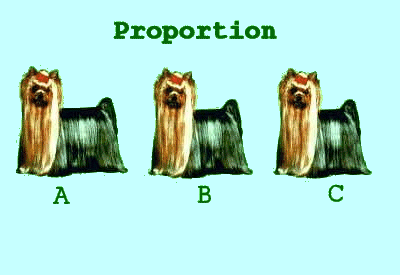 .
B is the best proportioned. .
B is the best proportioned.
A is too short in leg, C is too long in leg.
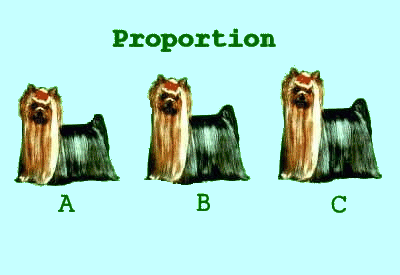 . . |
| HEAD |
| . |
Yorkshire Terrier
AKC Standard.
Small and rather flat on top, the skull not
to prominent or
round, the muzzle not to long, with the bite
neither undershot
nor overshot and teeth sound. Either scissors
bite or level bite
is acceptable. The nose is black. Eyes are
medium in size and
not too prominent; dark in color and
sparkling with a sharp,
intelligent expression. Eye rims are dark.
Ears are small,
V-shaped, carried erect and set not to far
apart. |
| . |
Carolyn Hensley Judging
Interpretation of the Standard.
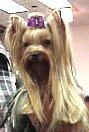 . .
Again, relative proportion comes into play
here. The head small,
which is a relative term, it would be clearer
to judges if the term
“in proportion to the body” were to be
introduced into the
language.
.
The skull not to prominent or round. This
would tell you that
the dog needs a moderate stop or the skull
can become prominent or round appearing. And why the
encouragement of the helmet like poufs on the head? Encourage a more
natural look when judging the breed and perhaps some brave soul
will do the twin top knots ala the Maltese and show off a good
Yorkshire head.
.
The muzzle not too long. Again in proportion.
It also does not
state the muzzle should be short just not too
long, major
difference.
.
Teeth sound. My goodness the dogs that finish
or are specialed
in this breed with missing, misshapen, dirty
and so forth teeth is
amazing and goes totally against the word
sound. It goes on to
state the bite is neither undershot nor
overshot with no preference to scissors or level bites.
.
Nose black. Eye rims are dark. If you stop to
consider this it is to
encourage the pigmentation a requirement if
this breed is going
to hold correct color.
.
Eyes are medium in size and not too
prominent. This contradicts
the tendency to what is commonly called a
baby-doll face as in
that look with the short muzzle the eye is
large and round. Dark
in color does not say black does not say
hazel or any other shade
other then dark. However, again the attitude
of sparkling with a
sharp intelligence; I want to remind you this
is a toy terrier think
of that expression in the bulk of the terrier
breeds.
.
Ears small, v shaped, carried erect and not
too far apart. This
does not mean they are to touch on top of the
head, they should
be set apart or why would the standard state
not too far apart?
Small, in proportion again as it does not
give you a reference to
the word small. V shaped gives you a good
visual of a prick ear
coming to a point on the end.
B is the correct head carriage. A is too short
and C is too long of a neck.
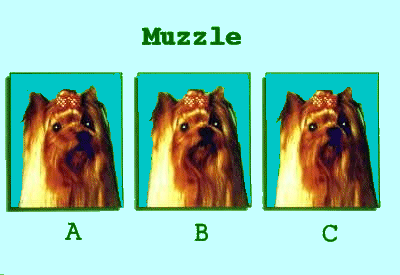
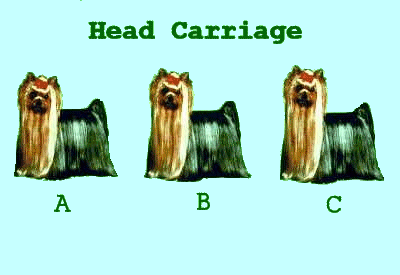 ..
B is the correct muzzle. ..
B is the correct muzzle.
A is too downfaced, C is too short.
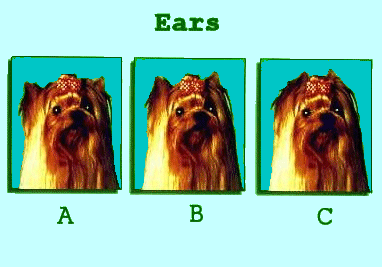
B is the correct ear set.
A's ears are too wide, C's ears appear to be
tied up.
|
.
| NECK, TOPLINE AND BODY
|
| . |
Yorkshire Terrier
AKC Standard
.
Well proportioned and very compact. The
back is rather short,
the back line level, with height at
shoulder the same as at the
rump. The dog’s high head carriage and
confidential manner
should give the appearance of vigor and
self – importance.
TAIL-docked to a medium length and
carried slightly higher
than the level of the back. |
| . |
Carolyn Hensley Judging
Interpretation of the Standard.
 . .
Once more is repeated: The body is neat
– look up this word in
the dictionary. Compact again going to
the old English term means:
closely and firmly united or packed
together; heavy and compact in form or stature; "a wrestler of
compact build"; "he was tall and
heavyset"; "stocky legs"; "a thick
middle-aged man"; "a thickset
young man" [syn: heavyset, stocky, thick,
thickset] .
.
Well proportioned, not one area should
stand out from the other
it means: Agreeable or harmonious
relation of parts within a
whole; balance or symmetry.
.
However, here again is introduced is
that the back should be
rather short. Does this mean
short-backed, no, although it is
interpreted that way by many. The
precedence is on proportion,
neat and so forth as descriptors.
However, preference should be
that the back is RATHER short over the
longer backed animals.
.
The backline level. Note it does not say
the back, nor does it say
the spine, it states the backline with
the height at the shoulder the
same as at the rump. Unfortunately, this
is many times achieved in the ring by a straight shoulder and
tilted pelvis. Do not judge
the toplines with the exhibitor on the
floor holding the dog straight and pushed together, let the dog
stand natural and look at the topline on the go around!
.
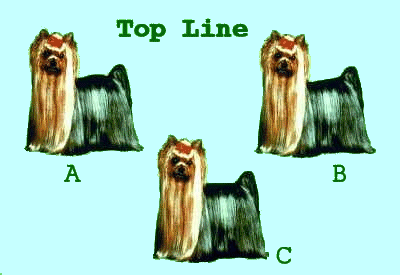
C has the correct topline.
A is roached back, B is down in the
shoulders.
 |
.
Tail is docked under AKC rules.
However docked or undocked
the carriage is more important. Note it
states carried slightly
higher the back, this does not mean high
up on the pelvis creating
a gay tail.
.
*AKC Judges Newsletter: Fall 2002
In accordance with Chapter 7, Section 15
of the Rules Applying to
Dog Shows, A judge's decision shall be
final in all cases affecting
the merits of the dogs. Full
discretionary power is given to the judge
to withhold any or all prizes for want of
merit.
.
It is the judge's interpretation of the
breed standard on the day.
In each of these situations you may judge
the exhibit and place
the dog you feel appropriate based on its
quality in comparison
to the other dogs being exhibited. Or,
you may excuse the dog
from the ring noting that the exhibit is
not consistent with the
breed standard, natural tail, natural
ears, etc.
.
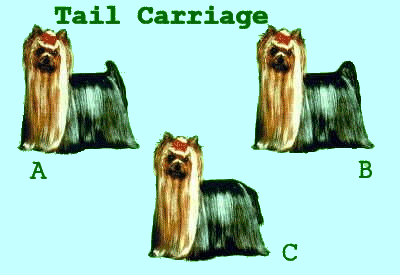
B has the correct tail carriage.
A is too far forward, C is down.
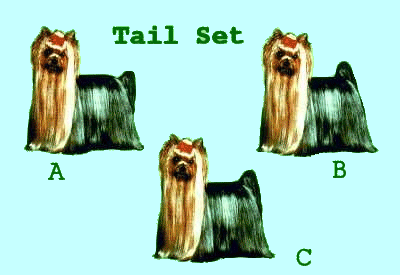
C is carried at a 45 degree angle
which is the correct tail set.
A is too low, B is too gay (high)
 .
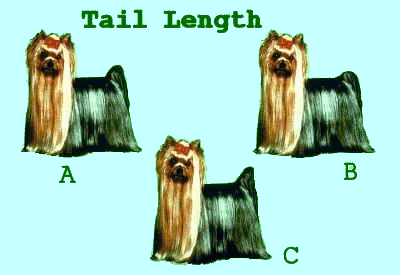
A has the correct tail length. .
A has the correct tail length.
B is too short, C is too long.
 . . |
| FOREQUARTERS, HINDQUARTERS, LEGS
AND FEET |
| . |
Yorkshire Terrier
AKC Standard.
Forelegs-should be straight, elbows neither
in nor out.
Hindlegs-straight when viewed from behind,
but stifles are
moderately bent when viewed from the sides.
Feet-are round
with black toenails. Dewclaws, if any, are
generally removed
from the hind legs. Dewclaws on the forelegs
may be removed. |
| . |
Carolyn Hensley Judging
Interpretation of the Standard.
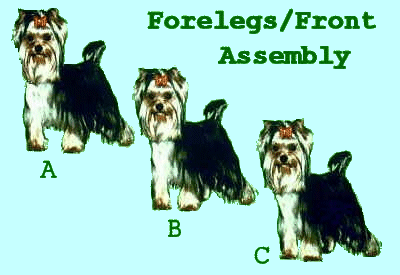
B has the correct front assembly.
A is too wide, C is too narrow.
. This section is very self explanatory but I
have introduced it
again in my interpretation of Gait. |
.
| GAIT |
| . |
Carolyn Hensley Judging
Interpretation of the Standard.
 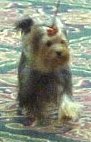 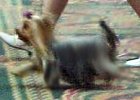 . .
There is nothing in the standard to describe
a Yorkshire’s gait.
But go back to general appearance, go to the
description of
the body and this tells you the type of gait
one should expect.
.
Here is my interpretation of what it should
be, taking my cue
from my terrier knowledge and exposure.
.
Should be free, light-footed, lively and
straightforward.
Hindquarters should have strong propelling
power. Toeing
in or out is to be faulted. As seen from the
front and from
the rear, the legs are straight from the
shoulder and hip joints
to the pads, and move in parallel to the
centerline of travel.
The rear legs move in the same planes as the
front legs. As
the dog moves at a faster trot, the front and
rear legs and feet
may tend to converge toward the centerline of
travel, but the
legs remain straight even as they flex or
extend. Viewed from
the side, the legs move in a ground covering
stride. The rear
feet should meet the ground in the same
prints as left by the
front feet, with no gap between them Topline
remains firm
and level, without bounce.
. |
.
| COAT |
| . |
Yorkshire Terrier
AKC Standard.
Quality, texture and quantity of coat are of
prime importance.
Hair is glossy, fine and silky in texture.
Coat on the body is
moderately long and perfectly straight (not
wavy). It may be
trimmed to floor length to give ease of
movement and a
neater appearance, if desired. The fall on
the head is long,
tied with one bow in center of head or parted
in the middle
and tied with two bows. Hair on muzzle is
very long. Hair on
muzzle is very long. Hair should be trimmed
short on tips of
ears and may be trimmed on feet to give them
a neat
appearance. |
| . |
Carolyn Hensley Judging
Interpretation of the Standard.
Now begins the portion that confuses many.
No where does it
say the coat is of prime importance, it
describes 3 (three)
features of the coat that are of prime
importance.
.
Quality- just what is meant by this word?
Again I would go
to the dictionary and find what the word
really means. To me
it says that the whole overall condition of
the coat and color
is of importance.
.
Texture – this again emphasizes that the
correct silk is of more
importance then the color which supports
that to reward a
soft coated dog, even if the clerical grey in
color over a lighter
dog with the correct blue hue which says the
correct structure is
there, is very wrong and should be
discouraged in judging.
.
Quantity – this says that the coat should
have sufficient
quantity with which to judge the texture and
quality.
.
The further descriptions are again very self
explanatory.
However, when thinking of silk I would advise
you to go to
a high end store and place your hand fore and
aft against and
feel the true heavy silk, feel the coolness
and let that sink into
your memory so that when your hands are going
over the
Yorkshire that memory is there.
.
Also, please note that no where does it state
the bow must be
red, although traditional many colors are
more flattering to
different shaded heads then the traditional
red. This should make
no difference to a judge as you are not there
to interpret bow
size or colour!
. |
.
| COLOR
|
| . |
Yorkshire Terrier
AKC Standard.
Puppies are born black and tan and are
normally darker in body
color, showing an intermingling of black
hair in the tan until
they are matured. Color of hair on body
and richness of tan
on head and legs are of prime importance
in adult dogs, to
which the following color REQUIREMENTS
apply: Blue-Is a
DARK steel blue, not a silver-blue and
not mingled with fawn,
bronzy or black hairs. Tan- All tan hair
is darker at the roots
than in the middle, shading to still
lighter tan at the tips. There
should be no sooty or black hair
intermingled with any of the
tan. Color on the body- The blue extends
over the body from
the back of neck to root of tail. Hair on
tail is darker blue,
especially at end of tail. Headfall- A
rich golden tan, deeper in
color at sides of head, at ear roots and
on the muzzle with ears
a deep rich tan. Tan color should not
extend down on back of
neck. Chest and legs-A bright rich tan,
not extending above
the elbow on the forelegs nor above the
stifle on the hind legs.
. |
| . |
Carolyn Hensley Judging
Interpretation of the Standard.
I don’t know how anything could be more
descriptive then this
section of the standard. It again
addresses that the coloration of
the puppy is NOT that of the adult dog
that is fully matured.
.
Note the color referenced is tan, darker
at the roots, Dark steel
blue and so forth.
.
Now how to judge the breed on color when
so many are
colored in the ring both on headfall and
body? Learn correct
texture and quality of a good coat and
reward it. When judging
part the coat at the front and rear leg,
if it is colored most do
not take the time and effort to check
underneath. Learn the
correct placement of the saddle and check
where the tan ends
and the blue starts, is a smudged line or
a clear demarcation?
The shading is always darker at the roots
in the blue and the
gold getting darker the further the shaft
is away from the body,
same color all the way and on a fully
mature adult, question
enhancements.
.
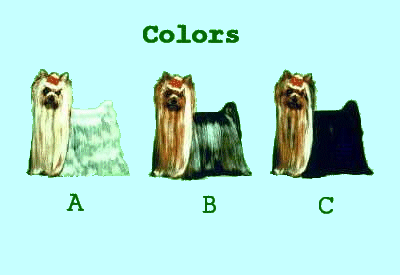
B is the correct color.
A is too light, C is black.
|
|